

Restorative Dentistry in Brno
Tooth-coloured fillings, root canal treatment and build-ups of damaged teeth. The aim of every procedure is to preserve as much of your natural tooth structure as possible.

Four ways to save a tooth
They differ in how deep the damage goes. We treat a small cavity with a filling, deeper damage with root canal treatment and a weakened tooth with a build-up.
Treatment of cavities and white composite fillings
We remove the decay and fill the tooth with composite matched to the shade of your tooth. We do not use amalgam.
More below
Root canal treatment (endodontics)
When decay reaches the nerve, or the tooth has suffered another kind of trauma. With root canal treatment we save the tooth instead of extracting it.
More about the procedure
Build-up of a damaged tooth
We restore the shape of a tooth after an injury or with a large filling, so that it can take the load of biting again.
More below
Inlays, onlays and overlays
A laboratory-made replacement for a large filling. Gentler on the tooth than a crown.
More belowSaving the tooth comes first
Restorative dentistry has a clear goal: to treat a tooth so that it lasts as long as possible. As long as the root is sound and there is something to save, it always makes sense. No replacement works as well as your own tooth.
What matters is how deep the damage goes. We treat a small cavity with a filling, deeper damage with root canal treatment, and a badly weakened tooth with a build-up and a crown.
Toothache or something has broken off? Give us a call - we handle urgent cases by phone.
Recommended first step - professional dental hygiene tailored to you
Check-up and X-ray - we find out how deep the damage goes
Plan and price - we explain the options and tell you the price in advance
Treatment - under local anaesthetic, usually in a single visit

Treatment of tooth decay and white composite fillings
Amalgam-free, matched to the shade of your tooth
Early decay does not hurt and can only be detected at a check-up or on an X-ray. While it is small, it is enough to remove it and fill the tooth. It is the quickest, gentlest and least expensive solution. If you leave it, it will eventually reach the nerve and the treatment then becomes considerably more demanding.
Show more
We remove the decay and fill the resulting cavity with composite, which we build up in layers directly in the tooth and cure with light. We choose the shade to match the surrounding enamel, so the filling is not noticeable at first glance. Composite bonds to the tooth both chemically and mechanically, so we do not need to remove more of the tooth than is absolutely necessary. We do not use amalgam fillings.- High-quality composite materials
- X-rays and more advanced imaging available
- Local anaesthetic as standard

Build-up of a damaged or chipped tooth
When a larger piece of the tooth is missing
A tooth that has been injured, has lost a wall or has had root canal treatment is weakened and at risk of fracturing. With a build-up we restore its shape and its ability to withstand the load of biting.
Show more
For smaller damage, a composite build-up is enough. When a larger part of the tooth is missing, we restore it with a crown or an overlay so that the tooth lasts.- Assessed using X-rays and a clinical examination
- We also treat front teeth after an injury
- Followed by a crown where needed
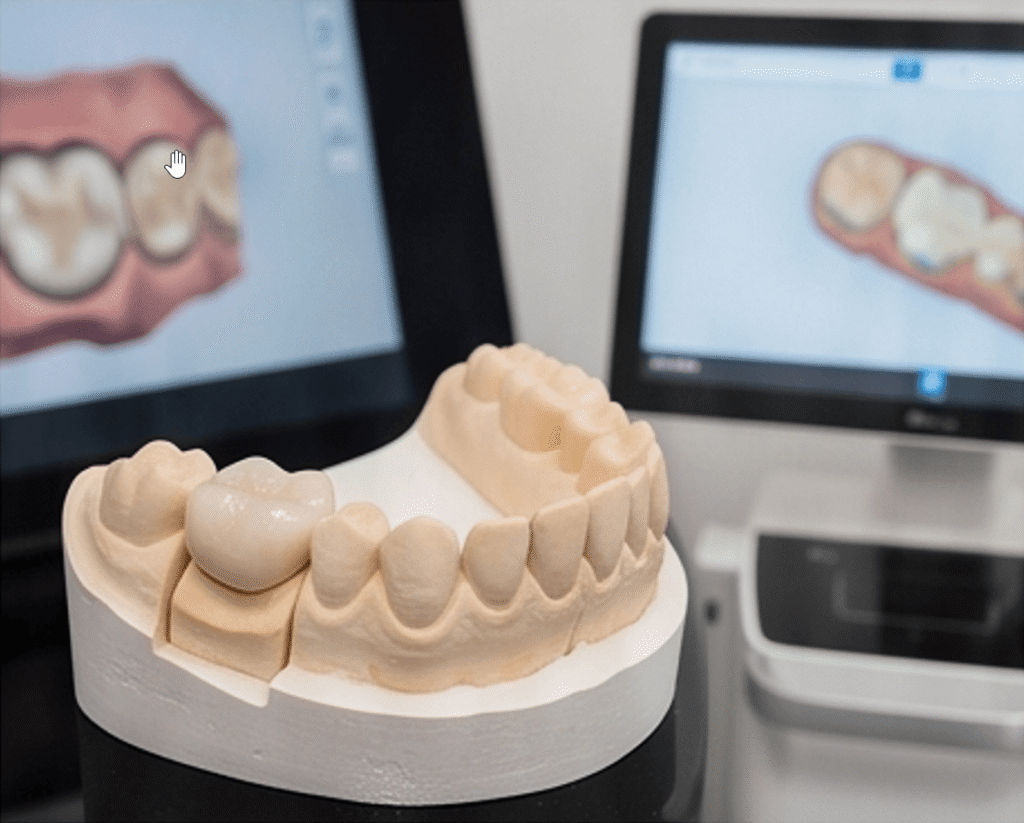
Inlays, onlays and overlays
When a filling would be too large
When little of the tooth remains, a direct filling has nothing to rest on and will eventually fracture. An inlay, onlay or overlay is a laboratory-made restoration bonded into the tooth, which spreads the load of biting across the whole tooth.
Show more
They differ in extent: an inlay fills a cavity inside the tooth, an onlay extends over a cusp, and an overlay covers the entire biting surface. Unlike a crown, the tooth is not ground down all the way around.- Preserves more of your own tooth than a crown
- Ceramic or composite, depending on the findings
- Two visits, with a temporary filling in between
What our patients say


Who will treat you



What patients ask us
Real questions from the clinic - answered by our dentists
Do you use amalgam fillings?
No. All our fillings are made of composite matched to the shade of your tooth.
Does health insurance cover fillings?
Health insurance covers basic treatment of decay. For composite fillings on back teeth, you pay the difference between the covered standard and the material used. We will tell you the exact amount before treatment.
Will the treatment hurt?
We work under local anaesthetic, so you will not feel anything during the treatment. Once it wears off, the tooth may be a little more sensitive for a day or two.
Can every tooth be saved?
No. If the tooth is fractured below the gum line or there is bone missing around the root, it cannot be saved and we look at a replacement. We will tell you at the check-up, before we start.
How long does a filling last?
It depends on the size of the filling and on how you clean your teeth. We check your fillings at every check-up and replace them in good time.
Book your appointment today
Call us or send us a message and we will get back to you within one working day.